


A state’s most common job shows which type of work employs the most people in that state.
It also points to local industries, population needs, consumer spending, and long-term labor trends.
Older job maps often featured manufacturing workers, secretaries, farmers, and truck drivers.
Recent maps show a shift toward food service, retail, healthcare support, logistics, and operations management.
Let’s check it out.
State-by-State Patterns
State
Common job
Category
Alabama
Retail Salespersons
Retail
Alaska
Retail Salespersons
Retail
Arizona
Fast Food and Counter Workers
Fast Food
Arkansas
Fast Food and Counter Workers
Fast Food
California
Home Health and Personal Care Aides
Home Health
Colorado
Fast Food and Counter Workers
Fast Food
Connecticut
General and Operations Managers
Management
Delaware
Retail Salespersons
Retail
Florida
Retail Salespersons
Retail
Georgia
Retail Salespersons
Retail
Hawaii
Fast Food and Counter Workers
Fast Food
Idaho
General and Operations Managers
Management
Illinois
Laborers and Freight, Stock, and Material Movers, Hand
Logistics
Indiana
Laborers and Freight, Stock, and Material Movers, Hand
Logistics
Iowa
Fast Food and Counter Workers
Fast Food
Kansas
Fast Food and Counter Workers
Fast Food
Kentucky
Laborers and Freight, Stock, and Material Movers, Hand
Logistics
Louisiana
Fast Food and Counter Workers
Fast Food
Maine
Home Health and Personal Care Aides
Home Health
Maryland
General and Operations Managers
Management
Massachusetts
General and Operations Managers
Management
Michigan
Laborers and Freight, Stock, and Material Movers, Hand
Logistics
Minnesota
Home Health and Personal Care Aides
Home Health
Mississippi
Fast Food and Counter Workers
Fast Food
Missouri
Home Health and Personal Care Aides
Home Health
Montana
Fast Food and Counter Workers
Fast Food
Nebraska
Fast Food and Counter Workers
Fast Food
Nevada
Laborers and Freight, Stock, and Material Movers, Hand
Logistics
New Hampshire
Retail Salespersons
Retail
New Jersey
Home Health and Personal Care Aides
Home Health
New Mexico
Home Health and Personal Care Aides
Home Health
New York
Home Health and Personal Care Aides
Home Health
North Carolina
Fast Food and Counter Workers
Fast Food
North Dakota
Retail Salespersons
Retail
Ohio
Fast Food and Counter Workers
Fast Food
Oklahoma
Retail Salespersons
Retail
Oregon
Fast Food and Counter Workers
Fast Food
Pennsylvania
Home Health and Personal Care Aides
Home Health
Rhode Island
Retail Salespersons
Retail
South Carolina
Retail Salespersons
Retail
South Dakota
Registered Nurses
Healthcare
Tennessee
Laborers and Freight, Stock, and Material Movers, Hand
Logistics
Texas
General and Operations Managers
Management
Utah
General and Operations Managers
Management
Vermont
General and Operations Managers
Management
Virginia
Fast Food and Counter Workers
Fast Food
Washington
Fast Food and Counter Workers
Fast Food
West Virginia
Registered Nurses
Healthcare
Wisconsin
Home Health and Personal Care Aides
Home Health
Wyoming
Retail Salespersons
Retail
State job rankings group into several broad patterns. Food service, retail, healthcare, management, logistics, and manufacturing appear again and again because they employ large numbers of workers across very different state economies.
Service Work States

Fast food workers are the top occupation in many states because restaurants, drive-thru chains, quick-service counters, and coffee shops need large workforces.
A 2024-based list identified fast food workers as the top job in Arkansas, Colorado, Delaware, Georgia, Hawaii, Indiana, Kansas, Montana, Nebraska, Ohio, Oklahoma, Oregon, Rhode Island, Utah, and Virginia.
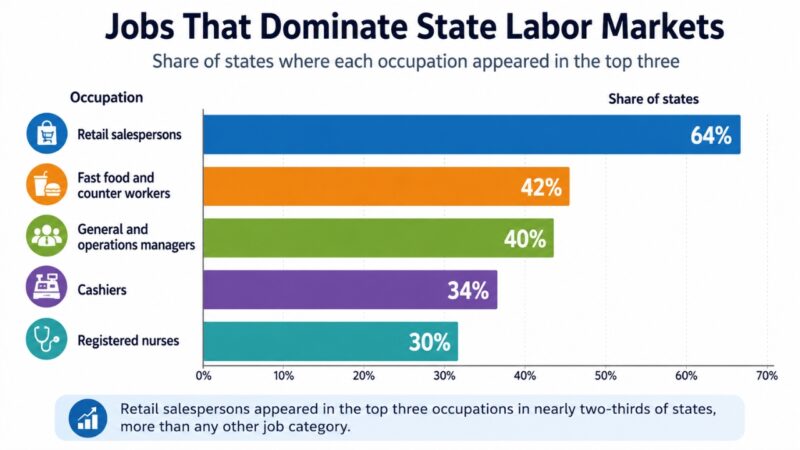
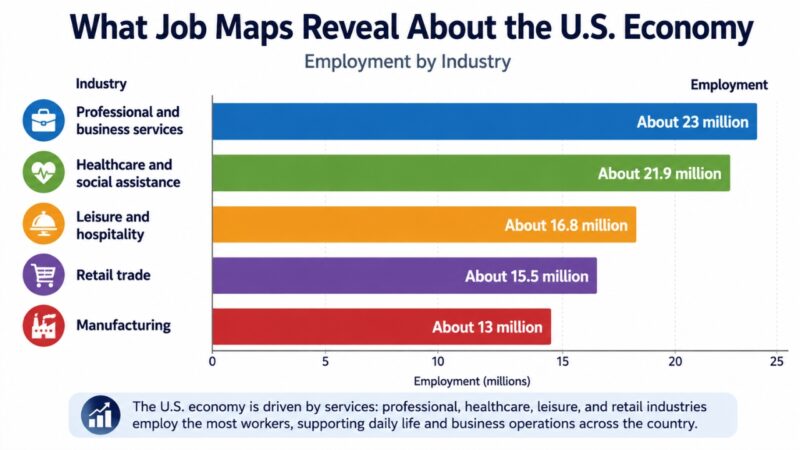
These rankings point to the scale of food service work in states with tourism, population growth, suburban expansion, highway travel, and local consumer demand. A 2024-based dataset listed retail sales and cashiers as the most common jobs in Alabama, Alaska, Florida, Iowa, Louisiana, Mississippi, North Carolina, South Carolina, Vermont, and Wyoming. Retail salespersons appeared in the top three jobs in 64% of states, the highest share among the occupations measured. Retail stays common because supermarkets, big-box stores, pharmacy chains, convenience stores, and shopping centers exist in nearly every community. Home health aides, personal care aides, and registered nurses rank highly because of aging populations, chronic health needs, and demand for in-home care. A 2024-based list showed home health aides as the most common job in California, Maine, Massachusetts, Minnesota, New Jersey, New Mexico, New York, Pennsylvania, Washington, and Wisconsin. Healthcare and social assistance are expected to drive job gains, especially because older populations and chronic conditions increase demand for care workers. General and operations managers, operations managers, and operations specialists rank first in several states. These roles cover workers who coordinate staff, budgets, schedules, logistics, and daily operations. A 2024-based list showed operations managers and specialists as the top job in Arizona, Connecticut, the District of Columbia, Idaho, Kentucky, Maryland, Missouri, New Hampshire, North Dakota, and Texas. General and operations managers appeared in the top three jobs in 40% of states. These rankings show that management work is widespread across business services, government, healthcare, retail, logistics, education, construction, and manufacturing. Freight movers, stockers, material movers, assemblers, and fabricators rank highly in states with warehouses, manufacturing plants, transportation corridors, and distribution centers. A 2024-based list identified freight movers as the top job in Illinois, Nevada, and Tennessee. Assemblers ranked first in Michigan. New research suggests that the logistics industry must move beyond fragmented sustainability measures and adopt integrated carbon-cutting strategies that combine greener transport, cleaner warehousing, circular economy practices and digital technologies. pic.twitter.com/QlDoF7NoKw — Devdiscourse (@Dev_Discourse) June 2, 2026 Transportation and warehousing are expected to be among the fastest-growing sectors between 2022 and 2032. Job gains are tied to couriers, delivery services, warehousing, storage, and e-commerce. Several occupations appear most often across state labor markets: Fast food workers lead the current count with first-place rankings in 17 states. In the 2024-based dataset, fast food workers led in 15 states. Retail sales and cashiers, home health aides, and operations managers or specialists each led in 10 states in the 2024-based dataset. Top-three-job data adds more context: Common jobs are often not high-paying or prestigious, but they are central to daily economic activity. America’s job map has changed sharply since the 1970s. Manufacturing once shaped many Midwest and Southern labor markets. Secretarial work grew as office-based services expanded. Farming employed more workers before technology reduced labor needs. Truck driving became common because goods had to move across the country. Truck drivers became a leading category because their jobs resisted globalization and automation for a long period. Regional specialization also declined, and government classifications grouped truck drivers and delivery workers into one large category. Secretarial work rose as offices expanded. Personal computers later reduced the need for many secretarial tasks because managers and professionals could handle typing, scheduling, filing, and communication directly. Manufacturing employment declined because of globalization and technology. Factories could produce more with fewer workers. Farming employment declined because agricultural technology allowed fewer workers to produce more food. In 1998, retail salespersons were the most common job in 39 states, while cashiers led in seven states. By 2024, fast food workers led in 15 states, and home health aides had become a major category. State job rankings show an economy centered on service work, retail, care work, logistics, and management. Food service and retail point to daily consumer demand. Healthcare support points to aging populations and long-term care needs. Logistics points to e-commerce, warehousing, delivery, and supply chains. Management points to the complexity of modern organizations. White-collar work is important, but it rarely becomes the largest single occupation in a state. Industry totals provide a wider context: High visibility does not always equal high employment volume. Many of the largest occupations are practical jobs tied to food, shopping, care, goods movement, and daily operations. A state’s most common job gives a clear snapshot of work for millions of Americans. Job maps have shifted away from older patterns centered on manufacturing, farming, secretarial work, and truck driving. Recent patterns lean toward food service, healthcare support, logistics, retail, and management. Common jobs show where everyday demand is strongest: food, shopping, care, movement of goods, and business operations. Fast food workers, retail salespersons, cashiers, home health aides, freight movers, registered nurses, and operations managers form the practical backbone of state economies.
Retail-Dominant States
Retail salespersons and cashiers still rank highly despite e-commerce and automation. Physical stores need workers for customer service, stocking, checkout, returns, displays, and daily operations.
Healthcare and Aging-Population States

Management and Professional-Service States
Logistics and Manufacturing States

Jobs That Dominate State Labor Markets
How Job Maps Changed?
What Job Maps Reveal About the U.S. Economy
Summary