America’s richest small towns are less about postcard charm and more about what happens when old land, new tech money, private schools, zoning limits, and generational wealth meet in places with very few homes for sale.
A quiet road can lead to an $8 million estate. A town with only a few thousand residents can sit closer to Wall Street, Silicon Valley, or Washington power than many large cities ever will.
The richest small town in America is Atherton, California, where the typical home value sits above $8.2 million.
Behind it are other ultra-wealthy enclaves in California, Texas, and the Washington, D.C. area, where median household income reaches the top Census reporting band and home ownership usually starts in the multi-million-dollar range.
The real story is not only who earns the most, but why small places have become some of the most expensive housing markets in the country.
How We Built the Ranking

We built the ranking by comparing small incorporated U.S. places with roughly 25,000 residents or fewer, then checking recent public income data against current local home-value data. The goal was to avoid a loose “rich town” list based only on reputation, headlines, or old luxury-market assumptions.
Our first filter was median household income from Census ACS data, using sources such as Census data and Census Reporter town profiles. Several ultra-wealthy communities are reported at $250,001 or $250,000+, which means the public data does not always show how far above that level local incomes go.
Because of that income cap, we used current housing values as a practical tiebreaker. For home costs, we checked local Zillow market pages and Zillow’s ZHVI methodology, which tracks home values by geography and housing type.
That gave the ranking a stronger real-world layer: what households earn, and what buyers actually face when trying to purchase a home there.
Some wealthy places may rank differently if net worth, average income, or only recent home sales are used instead. For a reader-friendly 2026 comparison, median household income plus current home value gives the clearest public snapshot.
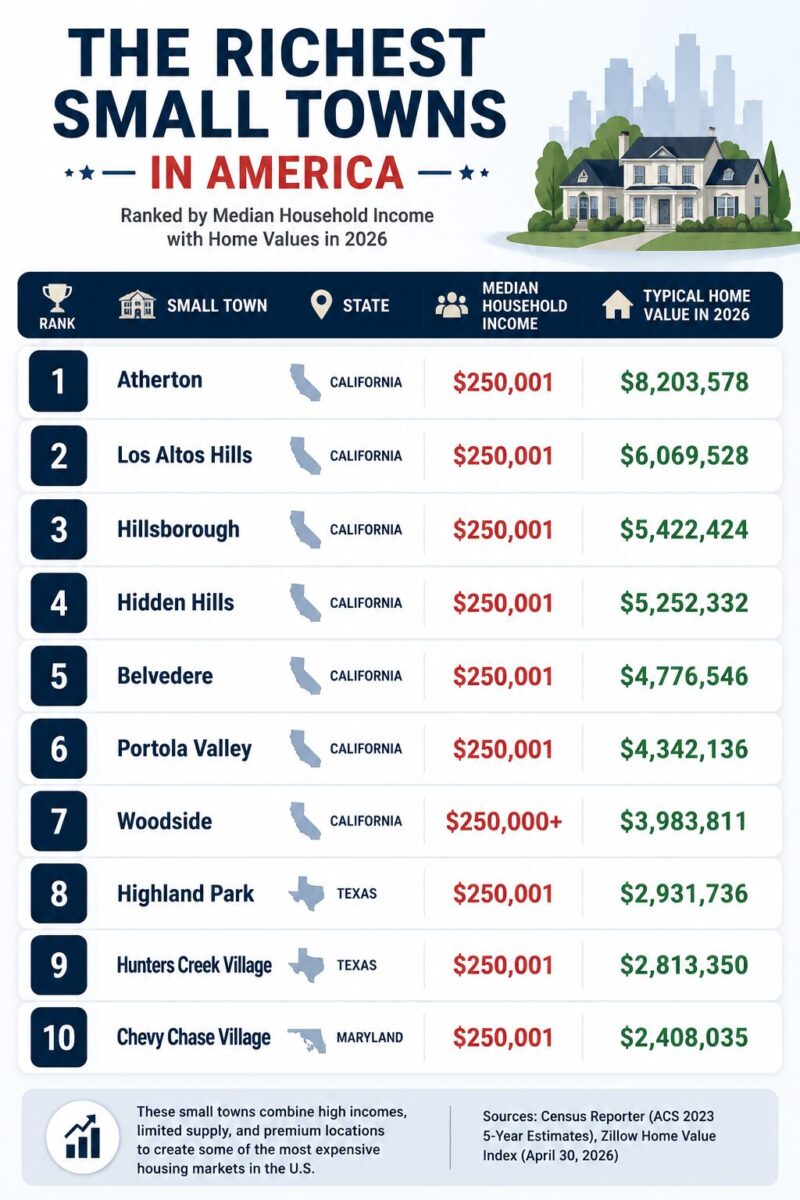
Quick Comparison: Richest Small Towns and Home Costs in 2026
Rank
Small Town
State
Median Household Income
Typical Home Value in 2026
Why It Ranks High
1
Atherton
California
$250,001
$8,203,578
Silicon Valley wealth, huge lots, extreme scarcity
2
Los Altos Hills
California
$250,001
$6,069,528
Tech executives, hillside estates, limited density
3
Hillsborough
California
$250,001
$5,422,424
Peninsula estates near San Francisco and Silicon Valley
4
Hidden Hills
California
$250,001
$5,252,332
Gated celebrity enclave in Los Angeles County
5
Belvedere
California
$250,001
$4,776,546
Bayfront Marin County luxury market
6
Portola Valley
California
$250,001
$4,342,136
Rural Silicon Valley privacy and acreage
7
Woodside
California
$250,000+
$3,983,811
Equestrian estates and tech wealth near Sand Hill Road
8
Highland Park
Texas
$250,001
$2,931,736
Dallas wealth, elite schools, central location
9
Hunters Creek Village
Texas
$250,001
$2,813,350
Houston Memorial Villages luxury market
10
Chevy Chase Village
Maryland
$250,001
$2,408,035
Washington, D.C. wealth, old housing stock, limited supply
1. Atherton, California
@mystical.maps The richest city in the U.S. – where even the streets “shine with gold.” #maps #map #viraltiktok #viral #usa #geography #fyp ♬ original sound – Mystical Maps
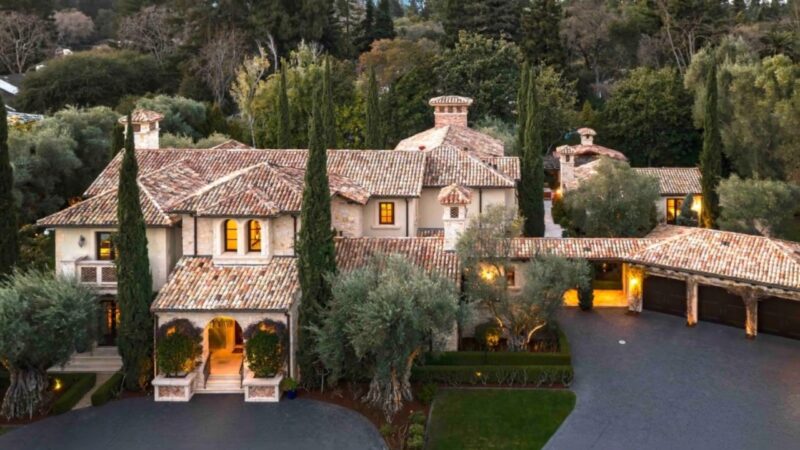
Atherton is the clearest answer for America’s richest small town when income and home cost are weighed together. Census Reporter lists Atherton’s median household income at $250,001, and Zillow’s local market page puts the average home value at $8,203,578 as of April 2026.
Atherton sits in San Mateo County between Menlo Park, Redwood City, and Palo Alto. Its wealth is tied directly to Silicon Valley. Founders, venture capital partners, public-company executives, early employees, and inherited Bay Area wealth all compete for a tiny number of properties.
A normal buyer should not read the Atherton home value figure as a mansion-only number. In Atherton, land often drives price. Large lots, mature trees, privacy walls, and proximity to Stanford, Sand Hill Road, and major tech campuses create an unusually deep luxury market.
2. Los Altos Hills, California
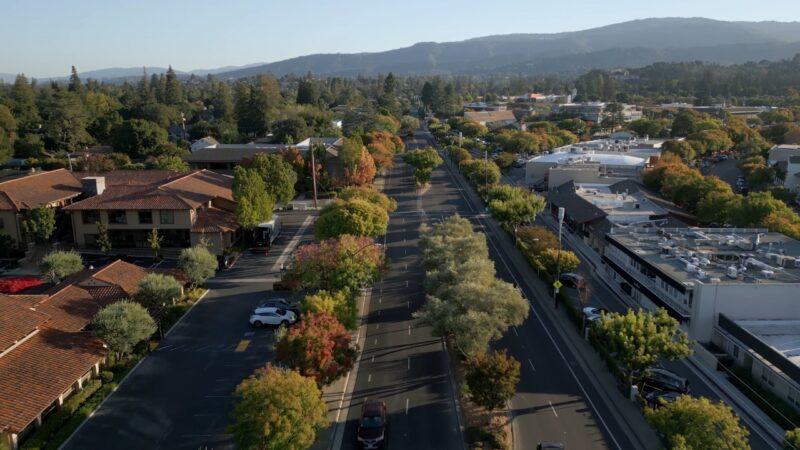
Los Altos Hills ranks near the top because it combines very high incomes with one of America’s most expensive residential markets. Census Reporter lists median household income at $250,001, while Zillow gives Los Altos Hills an average home value of $6,069,528 as of April 30, 2026.
The town is different from nearby Los Altos, which is larger and more urban by comparison. Los Altos Hills has a more residential, low-density feel, with hillside roads, large parcels, and heavy demand from technology-sector buyers.
The local housing market is hard to scale because the town does not have much room for large new subdivisions. That scarcity keeps prices high even when broader Bay Area housing cools, especially in areas where buyers are less dependent on conventional mortgage affordability.
3. Hillsborough, California
Hillsborough is a Peninsula estate town where high income meets historic land control. Its Census profile shows a median household income of $250,001, and Zillow lists the average home value at $5,422,424 as of April 2026.
The town sits near Burlingame and San Mateo, with quick access to San Francisco, San Francisco International Airport, and Silicon Valley job centers. Large homes, winding roads, and low-density zoning define the market.
Hillsborough also shows why “small town” does not mean inexpensive or quiet in a rural sense. It is small by population, but its buyer pool is regional, national, and global. The local real estate market reflects income, wealth, and geography at the same time.
4. Hidden Hills, California
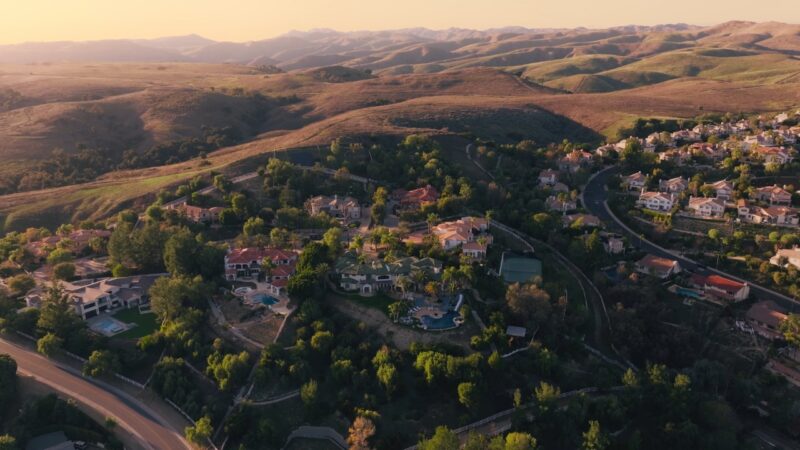
Hidden Hills is one of the wealthiest small municipalities in Southern California. Census Reporter lists the median household income at $250,001 for Hidden Hills, while Zillow puts the average home value at $5,252,332 in April 2026.
The community is gated and sits in Los Angeles County, near Calabasas and the western San Fernando Valley. Its brand is privacy. Large lots, equestrian zoning, and celebrity ownership help keep demand strong.
Hidden Hills differs from Bay Area towns because the wealth base is more connected to entertainment, business ownership, sports, and private capital than pure technology employment. Housing supply remains narrow, so prices can move sharply when a few large estates trade.
5. Belvedere, California
View this post on Instagram
Belvedere is a tiny Marin County city with outsized wealth. The town’s median household income is listed at $250,001, and Zillow reports an average home value of $4,776,546, up 5.1% over the past year as of April 2026.
The town sits on the Tiburon Peninsula, facing San Francisco Bay. Many homes have water views, dock access, or direct proximity to one of the Bay Area’s most desirable waterfront settings.
Belvedere’s housing market is constrained by geography. There is no easy way to add large volumes of housing on a small bayfront footprint. That physical limit helps explain why a town with fewer residents can carry prices comparable to major global luxury neighborhoods.
6. Portola Valley, California
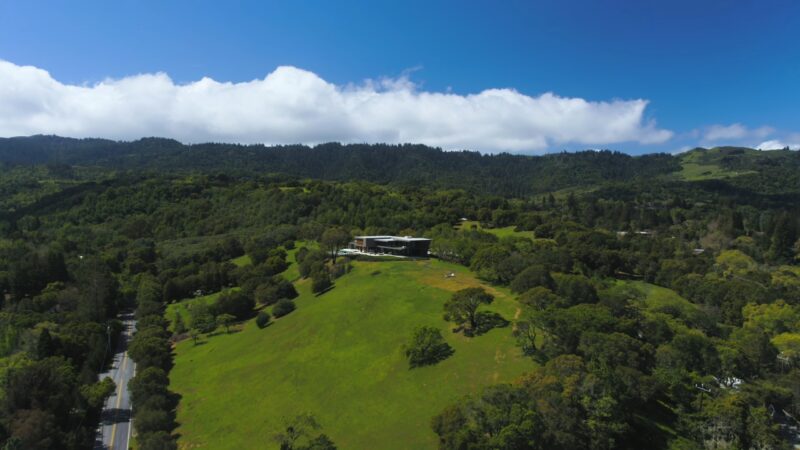
Portola Valley is a small Silicon Valley town where rural character and extreme wealth overlap. Census Reporter lists its population at 4,305 and median household income at $250,001. Zillow reports an average home value of $4,342,136, up 9.7% over the past year.
The town sits west of Stanford and Menlo Park, close enough for tech and venture capital commutes but far enough to feel secluded. Trails, open space, large parcels, and a lower-density planning pattern shape local demand.
In 2026, Portola Valley remains especially sensitive to stock-market wealth and tech liquidity. A strong IPO or AI-fueled equity cycle can affect buyer confidence more than a small change in mortgage rates, because many buyers rely on cash, stock proceeds, or large down payments.
7. Woodside, California
16-story project proposed in Woodside, CA—median home value $5 million. Would be first multi-family in Woodside history
Most amazing about this proposal: City staff kept it a secret for more than TWO YEARS since 2024. Just did not tell anyone, including their own council pic.twitter.com/WOIVvZkeDq
— Dr. Jeremy Levine, PhD of city council meetings (@JeremyELevine) May 22, 2026
Woodside belongs in any serious list of America’s richest small towns. The Census Bureau profile lists Woodside’s median household income as $250,000+ and total population at 5,309, while Zillow shows an average home value of $3,983,811 in April 2026.
The town is known for equestrian estates, redwood-lined roads, and proximity to both Silicon Valley and the coast. It is also near Menlo Park and Sand Hill Road, making it highly attractive to venture capital and technology wealth.
Woodside prices can look lower than Atherton or Los Altos Hills on an average-value basis, but that can be misleading. The local market includes large rural parcels, hillside homes, and ultra-high-end compounds. Averages can move depending on which part of town sees activity.
8. Highland Park, Texas
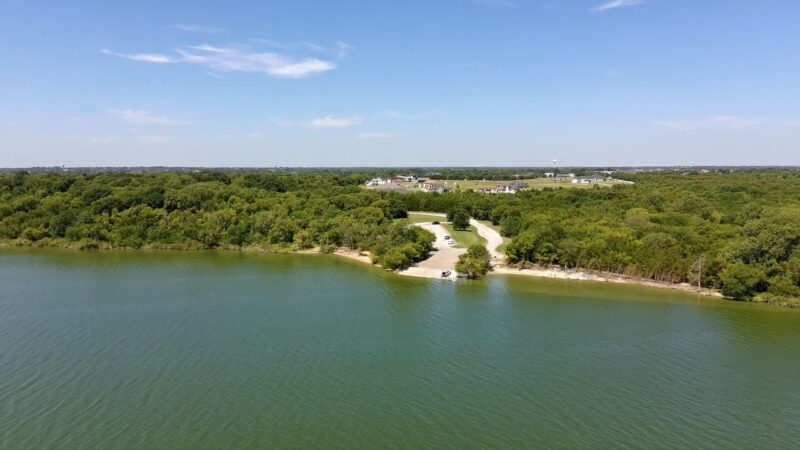
Highland Park is one of America’s richest small towns outside California. Census Reporter lists its median household income at $250,001, and Zillow reports an average home value of $2,931,736 for the Highland Park market, up 4.6% over the previous year.
Located inside the Dallas area, Highland Park benefits from a rare mix: central location, prestige, strong local schools, mature streets, and limited land. It is small geographically, but deeply connected to Dallas finance, law, energy, private equity, and executive wealth.
The local income profile also shows why Highland Park competes nationally. A nearly $3 million average home value is far below Atherton’s level, but it remains extraordinary for Texas and several times higher than broader Dallas-area prices.
9. Hunters Creek Village, Texas
Hunters Creek Village is part of Houston’s Memorial Villages, a cluster of independent municipalities known for large lots and high incomes. Census Reporter lists median income at $250,001, and Zillow reports an average home value of $2,813,350, up 12.7% over the past year.
The town’s appeal comes from privacy, mature neighborhoods, access to Houston employment centers, and a luxury market shaped by energy, medical, legal, and business-owner wealth.
The 12.7% one-year Zillow increase stands out. It suggests that demand at the top of Houston’s housing market remained strong even while many U.S. buyers were pressured by elevated borrowing costs.
10. Chevy Chase Village, Maryland
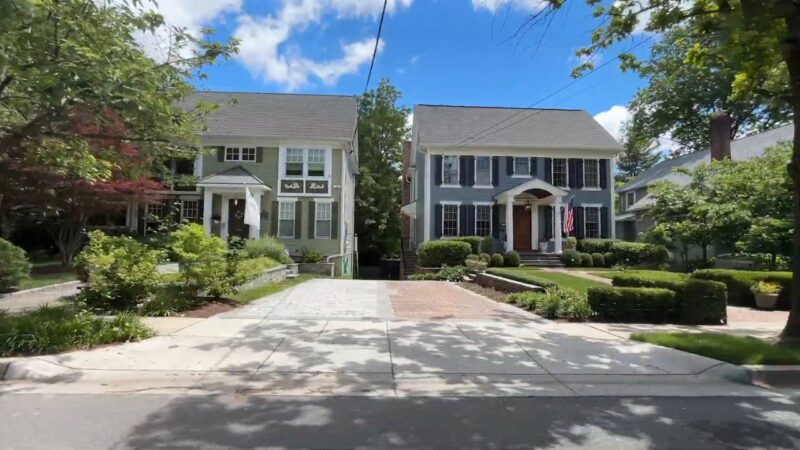
Chevy Chase Village is one of the wealthiest small municipalities in the Washington, D.C. region. Census Reporter lists median household income at $250,001, while Zillow reports an average home value of $2,408,035 for Chevy Chase Village, down 1.4% over the past year as of April 30, 2026.
The village sits near the D.C. border, Bethesda, and major professional corridors. Wealth here is often tied to law, finance, consulting, lobbying, medicine, government-adjacent work, and long-held real estate.
Chevy Chase Village differs from newer luxury suburbs because much of its value comes from location and old, established housing stock. Buyers pay for access, neighborhood identity, tree canopy, walkability to nearby commercial areas, and scarcity near the capital.
Why So Many Rich Small Towns Are in California
California dominates the list because the Bay Area and Los Angeles combine high household incomes with severe housing scarcity. Atherton, Los Altos Hills, Hillsborough, Portola Valley, Woodside, and Belvedere all benefit from one or more of the same forces:
The broader California Census data also shows state-level median household income far below the $250,001 figure seen in many of the towns above. That gap highlights how concentrated wealth can be inside small local jurisdictions. Income rankings among ultra-rich towns are less precise than they appear because public Census tables often stop at $250,001 or show $250,000+. In practical terms, Atherton and Highland Park may both appear at the same income threshold, even though income distribution, wealth, stock ownership, and home equity can differ sharply. Home values add another layer. A town with retirees and inherited wealth may have lower reported household income than a town full of active executives, even though home prices are just as high. Palm Beach, Florida, is a good example of a place with enormous wealth and luxury real estate, but income-based rankings may not capture the full net worth. For readers comparing towns, the median household income answers one question: what typical households report earning. Home values answer another: how expensive local ownership has become. Net worth would answer a third question, but reliable town-level net-worth data is rarely public. A “typical” home in one of America’s richest small towns usually costs far more than a national luxury benchmark. In the 10 towns above, the 2026 Zillow figures run from about $2.4 million to $8.2 million. That spread matters. A buyer moving from Chevy Chase Village to Atherton would not face a small premium. They would enter a market where the average home value is more than 3 times higher. A buyer moving from Highland Park to Los Altos Hills would also see a major jump, from roughly $2.9 million to more than $6 million. For a cash buyer, the biggest issue may be liquidity. For a financed buyer, the monthly carrying cost can become extreme, even with a large down payment. The richest small towns in America are expensive because wealth, land scarcity, privacy, and local reputation all stack together. High incomes help explain the ranking, but home prices tell the stronger story. In 2026, the towns at the top are places where buyers are paying for location, limited supply, larger lots, elite schools, and long-term prestige. For anyone comparing these communities, the real lesson is simple: a small population does not mean modest housing. In the wealthiest enclaves, even an “average” home often sits deep inside the luxury market.
Why Income Rankings Can Be Tricky

What a Home Actually Costs in Rich Small Towns
FAQs
Final Takeaway